Case Study

Reducing churn
in a task-based product

Reducing churn
in a task-based product

Reducing churn in a task-based product

Reducing churn by reshaping access models to match actual intent.

Reducing churn by reshaping access models to match actual intent.

Reducing churn by reshaping access models to match actual intent.

A displeased viewer watching Prime on TV

📌 Context

📌 Context

The product is an AI translation tool primarily used for short, project-based work.


Key observations:

• High churn on the 30-day monthly plan

• Many users complete one task, leave, then return weeks later

• The product performs better when login is not forced

The product is an AI translation tool primarily used for short, project-based work.


Key observations:

• High churn on the 30-day monthly plan

• Many users complete one task, leave, then return weeks later

• The product performs better when login is not forced

🚩 The Problem

🚩 The Problem

The product was positioned around a habit-based subscription model, but real usage behavior was task-based.

👀 Frictions

👀 Frictions

Users did not need ongoing access

• Monthly auto-renew felt misaligned with intent

• Retention mechanics were being applied where repetition was not natural

• Monthly auto-renew felt misaligned with intent

• Retention mechanics were being applied where repetition was not natural

😰 Tension

😰 Tension

Business goals favored predictable recurring revenue, while user behavior indicated short, intentional usage cycles.


The question was not how to force retention, but how to monetize honestly without damaging trust or conversion.

Business goals favored predictable recurring revenue, while user behavior indicated short, intentional usage cycles.


The question was not how to force retention, but how to monetize honestly without damaging trust or conversion.

🤔 Options considered

🤔 Options considered

1. Keep the 30-day auto-renew plan

• Optimize messaging
• Push retention earlier in the funnel

• Optimize messaging
• Push retention earlier in the funnel

2. Push account creation earlier

• Apply login gating more aggressively
• Limit access without an account

• Apply login gating more aggressively
• Limit access without an account

3. Introduce access models aligned with real usage

• Short-term access

• Flexible commitment

• Lower friction for return users

• Short-term access

• Flexible commitment

• Lower friction for return users

✨ The decision

✨ The decision

I recommended restructuring access to match how users actually behaved, without manufacturing artificial retention.

What I proposed

What I proposed

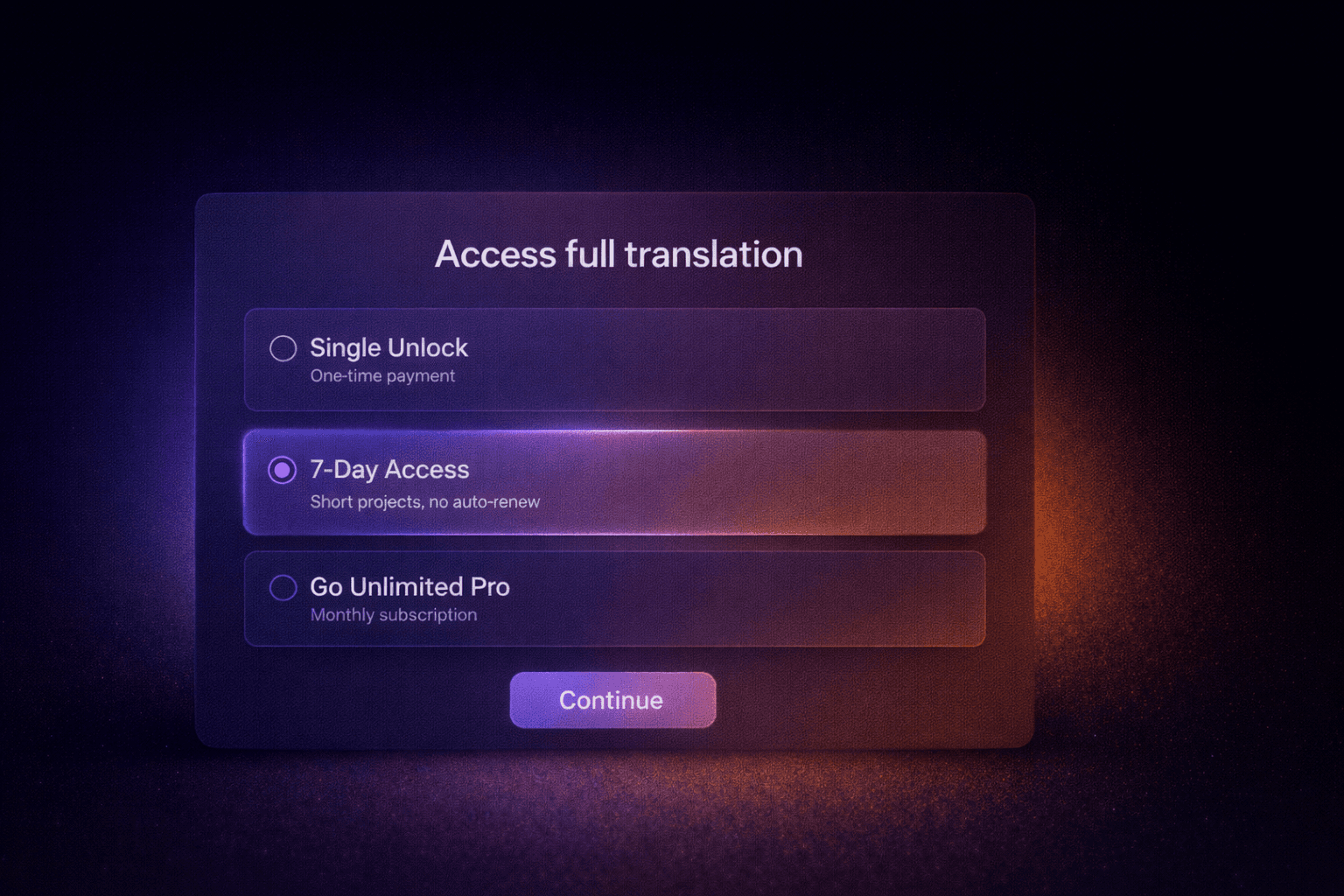
1. Add a 7-day access tier

• Lower cost

• No auto-renew

• Designed for short projects

• Lower cost

• No auto-renew

• Designed for short projects

  1. Introduce a pause option for heavy users

• Pause up to 30 days

• Auto-resume after pause

• Cancel anytime

• Pause up to 30 days

• Auto-resume after pause

• Cancel anytime

  1. De-prioritize login without removing it

• Login accessible via footer and “Go Unlimited” flow

• Account creation remains limited to Pro users

• Login accessible via footer and “Go Unlimited” flow

• Account creation remains limited to Pro users

4. Replace the header “Login” CTA

• New CTA: “Go Unlimited”

• Clear value signal

• Direct path to paid access

• New CTA: “Go Unlimited”

• Clear value signal

• Direct path to paid access

💸 Paywall context

💸 Paywall context

Available options:

• Monthly Unlimited (Pro)

• Single Unlock

• One-time payment

• No login required

• Lowest commitment

• Monthly Unlimited (Pro)

• Single Unlock

• One-time payment

• No login required

• Lowest commitment

Observed behavior:

• Many users started with Single Unlock, upgraded to Pro, then canceled later.

• Many users started with Single Unlock, upgraded to Pro, then canceled later.

📈 Outcome

📈 Outcome

  • “Go Unlimited” converted at nearly the same rate as the paywall

  • Reduced friction for returning users

  • Clearer alignment between pricing, access, and intent

Follow-up recommendation (not implemented)

Follow-up recommendation (not implemented)

Introduce the 7-day access tier earlier in the journey as a segmentation signal.

Use behavior across:

• Single Unlock

• 7-day access

• Monthly plans

• Single Unlock

• 7-day access

• Monthly plans

to guide upgrade paths before users reach Pro.

“Good products are not defined by the features they have, but by the problems they solve.”

“Good products are not defined by the features they have, but by the problems they solve.”

“Good products are not defined by the features they have,

but by the problems they solve.”

— Marty Cagan, Founder of SVPG

— Marty Cagan, Founder of SVPG

Got thoughts? I’m all ears.

I’m always up for thoughtful conversations.

I’m always up for thoughtful conversations.

Create a free website with Framer, the website builder loved by startups, designers and agencies.